
Does a Hunting License Work in Another State? Reciprocity Guide 2026
Separate the credential that transfers from the license, tags, stamps, and permits you still need to buy in the host state.
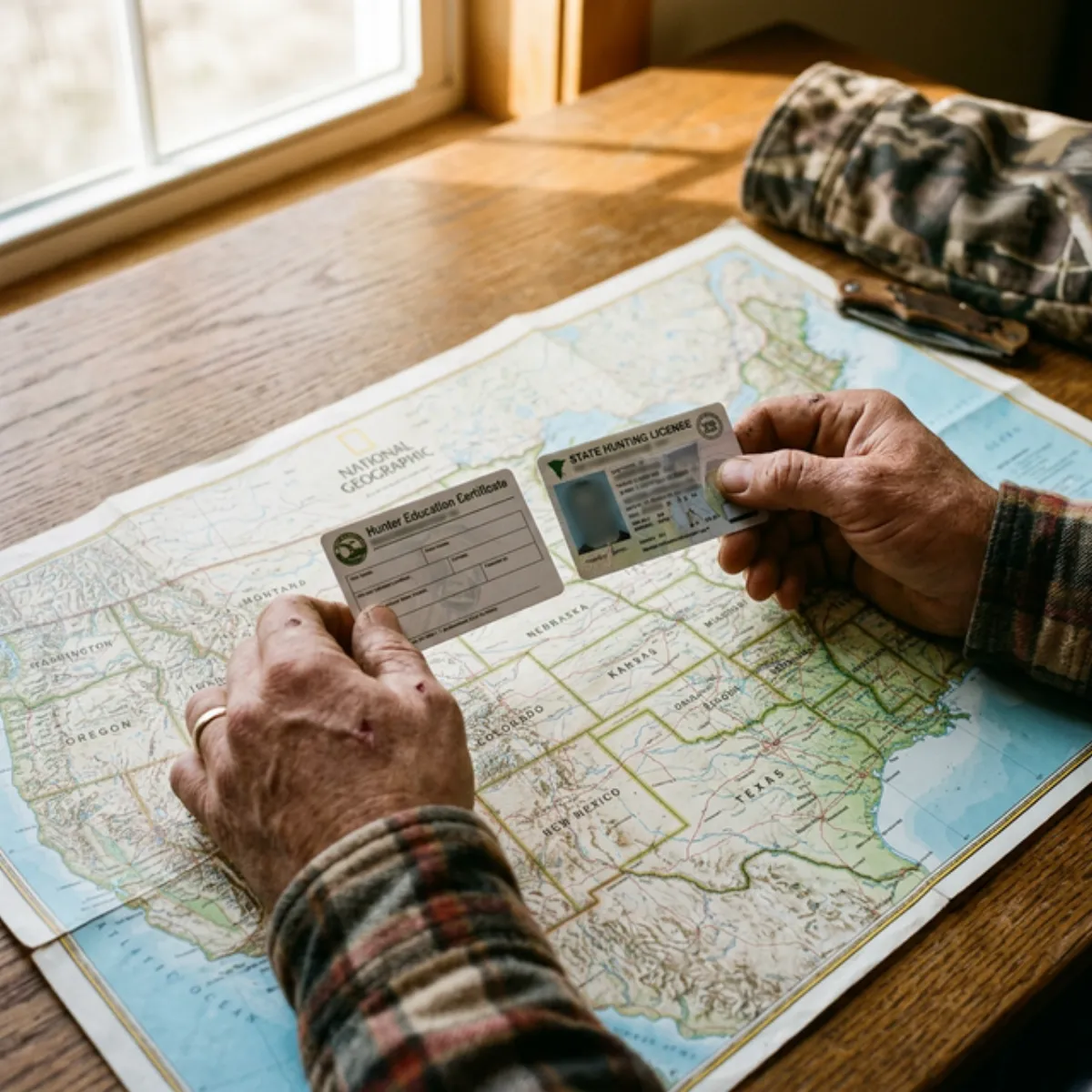
Planning Notes
- No: a hunting license issued by one state does not let you hunt in another state.
- Yes: an IHEA/AFWA-standard hunter education certificate is the credential that commonly transfers between state, provincial, and territorial wildlife-agency systems.
- You still need the host-state hunting license, species tag, stamp, HIP registration, access permit, and harvest-reporting step that applies to the hunt.
- Online-only or older paper certificates can require extra proof in some state portals, so verify the exact certificate and course type with the host wildlife agency before checkout.
- Active-duty military personnel may qualify for resident-rate licenses in some duty-station states, but that is a license-pricing benefit, not general license reciprocity.
- Use this page as a decision path, then confirm final eligibility, price, and proof requirements in the official host-state portal.
- For the narrower question "do hunting licenses work in other states?", use the independent state-specific license page and then return here for certificate-proof details.
In This Guide 11 sections
- Which Reciprocity Page Owns Your Question?
- Understanding Hunting License Reciprocity
- How the IHEA System Works
- State-by-State Reciprocity Reference
- How Online Courses Count Toward Reciprocity
- Military Status Is Not License Reciprocity
- Step-by-Step: Hunting in a New State
- Interstate Compacts Are Not License Reciprocity
- 2026 Official-Source Check
- Quick Reference: What Transfers And What Does Not
- Common Reciprocity Mistakes to Avoid
Which Reciprocity Page Owns Your Question?
Reciprocity searches split into three owners. This page owns the broad license-vs-certificate distinction. Use the short license-validity page when the user only asks whether one state license works somewhere else. Use the certificate checklist when the blocker is certificate proof, online-course format, or replacement-card routing.
| Visitor question | Owner page | Safe answer |
|---|---|---|
| Hunting license reciprocity between states | This page | A certificate may help across jurisdictions; a state hunting license does not become a multi-state hunting license. |
| Do hunting licenses work in other states? | Do hunting licenses work in other states | No. Buy the host-state resident or nonresident license before hunting there. |
| Are hunting licenses state specific? | Do hunting licenses work in other states | Yes. Licenses, tags, stamps, access permits and reporting steps belong to the host state. |
| Hunter education certificate reciprocity all states | Hunter education certificate reciprocity checklist | Certificate proof commonly helps, but the host state controls proof, course format and checkout acceptance. |
| Does hunter safety transfer from state to state? | Hunter education certificate reciprocity checklist | The AFWA resolution supports reciprocal acceptance of certificates from courses that meet IHEA-USA standards. |
| Do I need extra stamps or tags? | Host state hub or out-of-state hunting license guide | Yes, often. Reciprocity does not replace species tags, waterfowl proof, HIP, access permits, draw items or harvest reporting. |
Understanding Hunting License Reciprocity
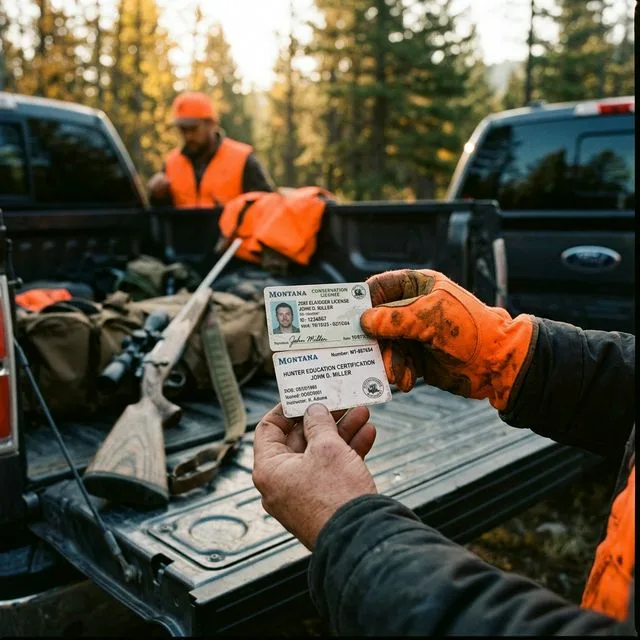
Hunting license reciprocity is often searched as if one hunting license might work across state lines. That is not how US hunting licenses work. The transferable credential is usually your hunter education certificate, not your hunting license.
- Hunter education reciprocity — Whether a state accepts your hunter education certificate from another state
- Hunting license reciprocity — Whether the actual hunting license from one state lets you hunt in another state
For practical planning, treat the answer this way: your hunter education certificate may satisfy the host state's education requirement, but you still need to buy the non-resident hunting license, tag, stamp, permit, or access pass required by the state where you will hunt.
How the IHEA System Works
The International Hunter Education Association (IHEA-USA) maintains hunter education standards and resources used by wildlife-agency programs. The official IHEA-USA site also links to the AFWA Reciprocity Resolution and state hunter education program directories.
The IHEA Certification Standard
The AFWA Reciprocity Resolution adopted September 25, 2024 says North American jurisdictions have established a reciprocity system that includes recognition of each other's certificates, and it encourages continued reciprocal acceptance of certificates showing completion of courses that meet IHEA-USA standards.
That is a certificate standard, not a multi-state hunting license. The host state can still decide:
- How the certificate must be shown or verified
- Whether online-only, field-day, bowhunter, trapper, or other course formats satisfy that state portal
- Whether a born-before exemption, apprentice path, or guide/outfitter rule changes the education requirement
- Which license, species tag, stamp, access permit, or reporting step is still required
IHEA standards and state programs commonly cover:
- Firearm safety and handling (minimum competency standards)
- Wildlife conservation principles
- Hunting laws and ethics
- Survival and first aid basics
- Practical field exercises where required by the issuing or host state
The Certificate Verification Process
When you purchase a hunting license in a new state, verification typically works through one of these methods:
- Certificate number lookup — Many state portals ask for the certificate number and issuing state
- Physical card presentation — Some vendors and field officers require your original certificate card
- State verification letter — If electronic verification fails, your home state can issue a verification letter
- Replacement-card records — IHEA-USA links to current and historic card resources by states, territories, countries, and provinces
Official starting points:
- IHEA-USA
- IHEA-USA Education Standards
- AFWA Reciprocity Resolution PDF
- IHEA-USA Hunter Education Cards
- IHEA-USA Hunter Education Programs By State
For the narrower "all states" certificate query, use the independent hunter education certificate reciprocity checklist. It keeps the proof packet, online-course boundary, and replacement-card route separate from this broader reciprocity page.
State-by-State Reciprocity Reference
Use This Safer State Check Instead Of A Static 50-State Claim
Because state portals, online-course rules, and proof requirements change, the safer state-by-state answer is a workflow:
| Step | What to verify | Why it matters |
|---|---|---|
| 1 | Host-state license requirement | Your home-state license does not create hunting privilege in the host state. |
| 2 | Certificate standard | The course should meet IHEA-USA or host-state hunter education standards. |
| 3 | Certificate proof | Older cards, lost cards, and out-of-state records may need a replacement card or issuing-state verification letter. |
| 4 | Course delivery | Online-only, online plus field day, bowhunter-only, and trapper-only certificates can be treated differently by a state portal. |
| 5 | Species layer | Deer, elk, turkey, waterfowl, bear, public-land, WMA, and draw hunts can add separate items. |
| 6 | In-field proof | Some states accept digital proof; others still expect paper or card backup in the field. |
Examples Of Host-State Questions To Ask
Before you buy, ask the official host-state portal or hunter education office these exact questions:
- Does this state accept my issuing state's hunter education certificate for this license type?
- Does my online-only or online-plus-field-day certificate satisfy the current rule?
- Do I need to upload the card, enter a certificate number, call the agency, or bring proof to a vendor?
- If I am exempt by age, military status, apprentice status, or outfitter rule, what proof do I need?
- Which separate tags, stamps, HIP registrations, WMA permits, draw applications, or harvest reports are still required?
About Strict-State Lists
Static lists that label states "full reciprocity" or "strict reciprocity" age quickly. The current safer rule is: assume the hunter education certificate may help, but do not assume it replaces host-state verification. If the official state portal gives a stricter answer for your exact certificate, the state portal controls.
How Online Courses Count Toward Reciprocity
Online hunter education is common, but online-course acceptance is not a one-line national answer. IHEA-USA publishes online course delivery standards, while the issuing state and host state decide whether the exact course format satisfies their current licensing portal.
What To Verify For Online Courses
Before relying on an online certificate across state lines, verify:
- The issuing state or province
- The certificate number
- Whether the course was online-only, online plus field day, classroom, bowhunter, or trapper
- Whether the host state portal accepts that format for the license you are buying
- Whether you need a replacement card, upload, phone verification, or in-person vendor check
The Field Day Question
The field-day question matters because some states distinguish hands-on and online-only course formats. Do not rely on a generic provider approval statement. Confirm your specific certificate with the destination wildlife agency before travel.
Best Practice For Online Course Students
If you completed an online-only course and know you'll hunt across state lines, consider:
- Completing a voluntary field day through your home state's wildlife agency
- Adding an advanced certification (bowhunter ed, turkey hunting safety) to strengthen your credentials
- Contacting the host state's agency in advance to verify your specific certificate's acceptance
Military Status Is Not License Reciprocity
Military status can change the price or eligibility path in a host-state checkout system, but it does not make one state's hunting license work in another state. Treat active-duty, dependent, veteran, and disabled-veteran benefits as separate official-source questions.
The host-state portal controls resident-rate treatment. If you are stationed in a state, maintain a home-of-record state, or are claiming a veteran or disabled-veteran product, verify that status in the current agency portal before you buy. Do not rely on a static state list inside a reciprocity article.
Use these guides for the military-specific proof path:
- Active-duty military hunting license guide — stationed status, home-of-record residency, dependent/spouse status, installation access, and active-duty proof packets
- Disabled veteran hunting license guide — VA disability proof, service-connected wording, resident/nonresident limits, lifetime or annual products, and post-benefit license stacks
Military Proof Packet
Before claiming a military resident-rate or reduced-fee product, prepare:
- Common Access Card or other active-duty military ID
- orders, duty-station paperwork, or LES if the state asks for it
- Home-of-record or ordinary residency proof when the product depends on residency
- VA disability letter, DD-214, or state-specific veteran proof when claiming veteran products
- Hunter education certificate, because military status does not automatically replace education proof
- Host-state license, species tag, stamp, HIP, access permit, draw item, or harvest-reporting proof that still applies to the hunt
Step-by-Step: Hunting in a New State
To ensure a smooth experience hunting across state lines, follow this checklist:
Before You Go
- Verify your certificate — Confirm your hunter education certificate is IHEA-approved by checking the IHEA-USA website or contacting your home state's wildlife agency
- Check host state requirements — Visit the host state's wildlife agency website for any additional certifications, orientations, or endorsements required
- Research license costs — Non-resident licenses vary dramatically by state. Compare costs at our hunting license cost by state reference
- Purchase licenses early — Some states sell limited non-resident tags that sell out quickly (e.g., Colorado elk tags, Montana deer permits)
- Review species-specific regulations — Season dates, bag limits, and legal methods vary significantly between states
Documents to Carry
- Hunter education certificate (original card if possible)
- Valid hunting license for the host state
- Species-specific tags and permits
- Government-issued photo ID
- Any required stamps (federal duck stamp for waterfowl, HIP registration for migratory birds)
- Military ID if claiming military rates
In the Field
- Know the host state's regulations — ignorance is not a defense
- Carry proof of all licenses and certifications at all times
- Be prepared for game checking and reporting requirements that differ from your home state
- Understand the host state's hunter orange requirements
- Know the legal shooting hours (they vary by state)
Interstate Compacts Are Not License Reciprocity
Hunters also confuse education reciprocity with interstate enforcement compacts. Those are different systems:
- Hunter education reciprocity helps a host state decide whether your safety training satisfies its education rule.
- Wildlife violator compacts can let states honor each other's license suspensions after serious violations.
- A hunting license still belongs to one state and one legal privilege stack.
There is no general interstate hunting license that lets a hunter buy once and hunt across state lines.
2026 Official-Source Check
For this update, the durable official source is not a static blog list of strict or lenient states. It is the IHEA-USA/AFWA standards and reciprocity framework plus the current host-state portal.
| Source | What it proves | What it does not prove |
|---|---|---|
| IHEA-USA Education Standards | IHEA-USA maintains hunter education standards and separate standards for beginner hunter education, bowhunter, trapper, and online course delivery. | It does not make another state's hunting license valid in the host state. |
| AFWA Reciprocity Resolution | AFWA encourages continued reciprocal acceptance of certificates showing completion of courses that meet IHEA-USA standards. | It does not remove host-state license, tag, stamp, permit, or reporting requirements. |
| IHEA-USA Hunter Education Cards | Certificate/card replacement and historic records are routed by state, territory, country, or province. | It does not guarantee a state portal will accept an incomplete, unverifiable, or wrong-course certificate. |
| Host-state wildlife agency portal | The final rule for your license purchase, certificate proof, age exemption, species tag, waterfowl stamp, or public-land permit. | It may not explain your home state's replacement-card process. |
Portable Documents Checklist
Carry or save these before an out-of-state hunt:
- Hunter education certificate number
- Issuing state, province, territory, or country
- Original card, PDF certificate, or replacement record
- Host-state nonresident license
- Species tag or permit
- Federal Duck Stamp proof when hunting migratory waterfowl age 16+
- HIP registration for migratory birds where required
- State waterfowl, habitat, WMA, public-land, or access permits where required
- Government photo ID
- Military orders or duty-station proof if claiming military resident-rate treatment
Quick Reference: What Transfers And What Does Not
| Item | Transfers? | User-helpful answer |
|---|---|---|
| Hunter education certificate | Usually, if it meets IHEA/AFWA or host-state standards | Bring the certificate number and proof; verify online-only or older cards with the host agency. |
| Hunting license | No | Buy the host-state resident or nonresident hunting license. |
| Deer, elk, turkey, bear, or other species tag | No | Buy or draw the host-state species item. |
| Federal Duck Stamp proof | Separate federal requirement | Waterfowl hunters age 16+ need current proof regardless of education reciprocity. |
| HIP registration | Usually state-specific | Complete HIP for the state and season where you hunt migratory birds. |
| Military resident-rate eligibility | Sometimes | Check the duty-station state and carry orders or military ID. |
| Landowner or senior exemption | Usually no | These benefits are tied to host-state residency, land, age, disability, or application rules. |
For license cost comparisons across states, see our hunting license cost by state reference. Planning your first out-of-state trip? Our hunt out of state on a budget guide shows you how to do it for under $500.
Common Reciprocity Mistakes to Avoid
- Assuming one license covers a second state — Your hunting license is state-specific. Your hunter education certificate may help satisfy the host state's education requirement, but that proof still needs host-state acceptance.
- Not carrying your physical certificate — While digital records exist, some field officers and vendors require the original card
- Ignoring additional endorsement requirements — Some states require extra endorsements (e.g., archery endorsement, muzzleloader endorsement) beyond the base license
- Forgetting federal and migratory-bird requirements — Federal Duck Stamp proof, HIP registration, and any state migratory-bird or habitat items must be checked for the species, age, state, and season you will hunt.
- Waiting until the last minute — License availability, especially for non-resident big game tags, can be limited. Purchase well in advance of season.
- Not checking online course acceptance — If your certificate is from an online-only course, verify acceptance with the host state before traveling
- Do Hunting Licenses Work in Other States? State-Specific Rules Explained A direct answer for whether hunting licenses work in other states: licenses are …
- Hunter Education Certificate Reciprocity: All-State Proof Checklist Hunter education certificate reciprocity guide: what commonly transfers, what do…
- Nonresident Hunting Tips: State, Cost, Access, And Proof Checklist Use this nonresident hunting checklist to avoid wrong products, route state-spec…
Frequently Asked Questions
Is my hunting license valid in other states?
No. A hunting license is a state-specific legal privilege and does not let you hunt in another state. What may transfer is your hunter education certificate. To hunt legally across state lines, buy the host-state license and any species tag, stamp, access permit, HIP registration, draw application, or harvest-reporting item required for that hunt.
What is the difference between hunting license reciprocity and hunter education reciprocity?
Hunter education reciprocity is about safety-training proof. The AFWA reciprocity resolution supports reciprocal acceptance of certificates for courses that meet IHEA-USA standards. Hunting license reciprocity would mean one state license creates hunting privilege in another state, and that is not the normal rule. Buy the host-state license even when your hunter education certificate is accepted.
Do all states accept online hunter education courses?
Do not assume. IHEA-USA maintains separate standards for online course delivery, but the host state portal controls whether your online-only, online plus field-day, bowhunter, trapper, or older paper certificate satisfies the current requirement. Before buying, verify your exact certificate number, issuing state, and course type with the host wildlife agency.
Can military personnel get resident hunting license rates in states where they are stationed?
Sometimes. Active-duty military resident-rate rules are state-specific. Treat them as a pricing or eligibility benefit, not license reciprocity. Check the duty-station state portal, then carry military ID and orders or other duty-station proof if the state requires it.
When should I double-check hunter education reciprocity?
A static strict-state list is risky because state portals change. The safer answer is to identify strict situations: online-only certificates, missing certificate numbers, older paper cards, bowhunter-only or trapper-only credentials, international certificates, and first-time host-state buyers. In those cases, contact the host-state hunter education office before checkout.
Do I need to retake hunter education if I move to a new state?
Usually no, but verify with the new state before checkout. Your certificate can commonly satisfy the education requirement if it meets IHEA/AFWA or host-state standards, but the new state may need your certificate number, issuing state, replacement card, or verification letter. Moving does not transfer your old hunting license; it only changes which resident or nonresident license rules may apply.
Does Canada accept US hunter education certificates?
The AFWA resolution describes North American reciprocity across state, provincial, and territorial wildlife-agency systems, but Canada hunting rules are provincial or territorial. Do not rely on a US hunting license in Canada. Confirm the province or territory accepts your certificate and buy the Canadian license, species tag, firearm import document, and outfitter arrangement required for that hunt.
What should I carry when hunting out of state?
Carry the host-state hunting license, species tags or permits, hunter education certificate proof, government ID, Federal Duck Stamp proof when waterfowl hunting age 16+, HIP registration where required, state stamps or WMA permits, private-land permission when applicable, and military duty-station proof if claiming a military license benefit. Keep state licenses and tags separated if you hunt more than one state on the same trip.
How do I verify if my hunter education certificate is IHEA-approved?
Start with the wildlife agency that issued the certificate. If you lost the card or the host-state portal cannot verify it, use the issuing state replacement-card process or the IHEA-USA Hunter Education Cards directory to find the right record path. Then confirm with the host-state portal that the certificate, course type, and proof format satisfy the current purchase requirement.
View Page Update History (4)
- 2026-08-09:Added top-of-page owner routing for license-vs-certificate reciprocity intent and narrowed overbroad transfer wording after AFWA/IHEA source review.
- 2026-06-13:Removed course-provider and retailer shortcuts, and routed military resident-rate questions to active-duty and disabled-veteran guides instead of a static state list.
- 2026-06-13:Rebuilt the reciprocity answer around the license-vs-certificate distinction, IHEA-USA standards, AFWA certificate-recognition resolution, and host-state verification steps.
- 2026-06-12:Clarified next-step routing through the shared intent network without changing state-specific fee claims.