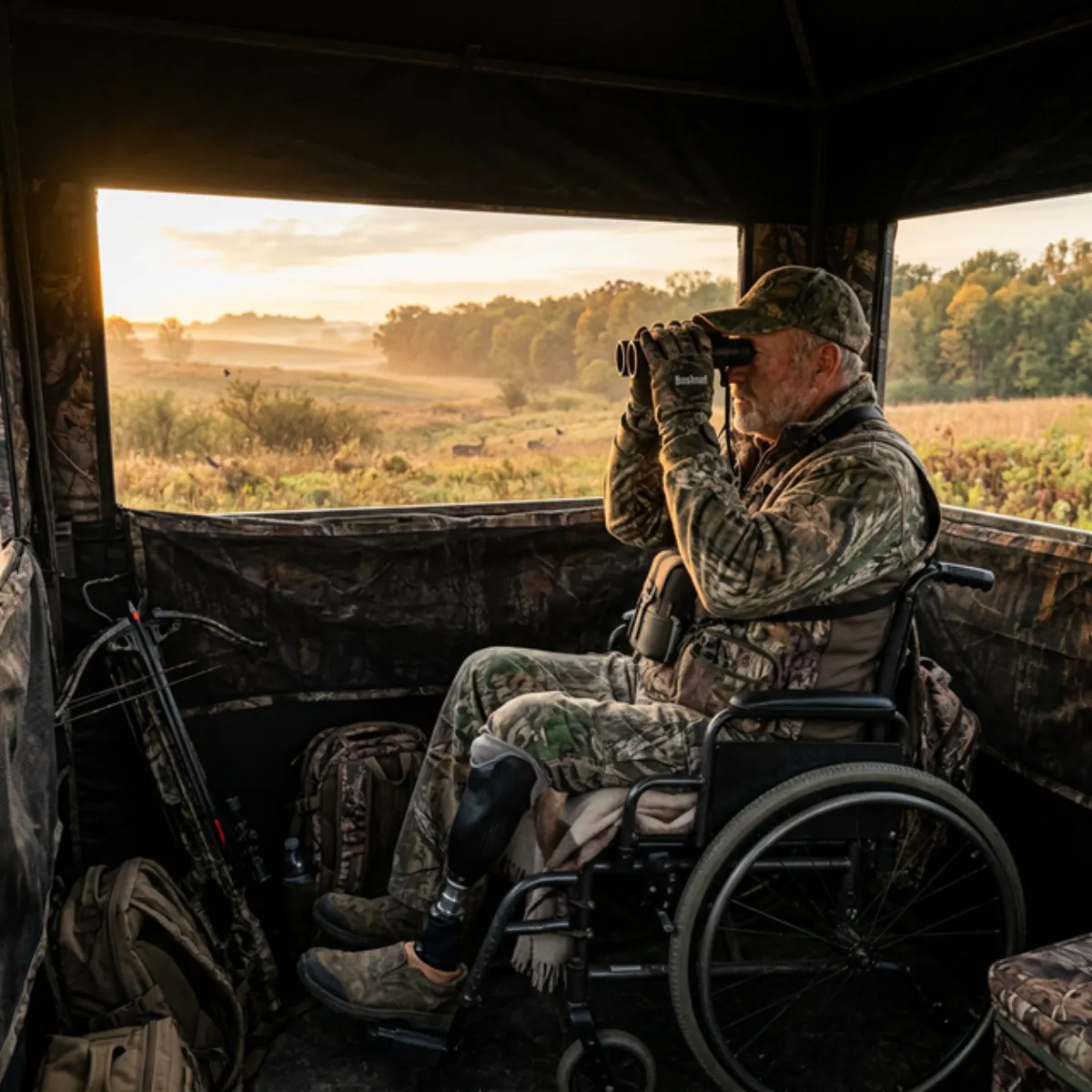
States With Free Hunting Licenses for Disabled Veterans (2026 Guide)
A comprehensive resource for disabled veterans seeking free or reduced-fee hunting privileges.
TL;DR — Key Takeaways
- Over 40 states offer free or reduced-fee hunting licenses for disabled veterans.
- Most programs require a service-connected VA disability rating — commonly 50%, 60%, or 100%.
- Some states provide free lifetime hunting licenses, while others offer annual waivers.
- Documentation requirements typically include a VA disability letter and proof of honorable discharge.
- Several states extend benefits to non-resident disabled veterans as well.
- Check our free hunting license overview for additional exemptions beyond veteran status.
In This Guide 7 sections
Why States Offer Free Hunting Licenses to Disabled Veterans
Hunting has long been recognized as a powerful therapeutic activity for veterans recovering from service-connected injuries and conditions like PTSD, traumatic brain injury (TBI), and mobility impairments. State wildlife agencies across the country have responded by creating programs that reduce or eliminate licensing costs for disabled veterans.
These programs serve a dual purpose: they honor the sacrifice of military service members while also encouraging disabled veterans to engage with nature, maintain physical activity, and participate in a community-oriented tradition that supports conservation.
For a broader look at all free license programs (including youth, seniors, and landowners), see our free hunting license by state reference page.
Understanding VA Disability Ratings
Before diving into state-specific programs, it's important to understand how the VA disability rating system works, since nearly every state pegs their hunting benefits to this rating.
How VA Disability Ratings Are Determined
The Department of Veterans Affairs assigns disability ratings in 10% increments from 0% to 100%. The rating reflects how much your service-connected condition impacts your ability to work and function in daily life.
Key Rating Tiers for Hunting Benefits
- 100% (Permanent and Total) — Qualifies for free licenses in the most states. This rating means the VA considers your condition(s) completely disabling and unlikely to improve.
- 70%+ — Many states use this as the threshold for free or deeply discounted licenses.
- 60%+ — A common mid-tier threshold. States like Delaware, Oklahoma, and Vermont use this benchmark.
- 50%+ — The entry-level threshold for several states including California, Maine, and Wyoming.
Individual Unemployability (TDIU)
Veterans rated at less than 100% but who are unable to maintain substantially gainful employment due to service-connected conditions may receive Total Disability based on Individual Unemployability (TDIU). Most states treat TDIU the same as a 100% Permanent and Total rating for license exemption purposes. Verify with the specific state's wildlife agency.
All 50 States: Disabled Veteran Hunting Benefits
Below is a comprehensive reference of every state's program for disabled veteran hunters. Benefits fall into four categories:
- Free License — No cost for the hunting license
- Reduced Fee — Discounted from full non-resident or resident price
- Lifetime — One-time qualification, no annual renewal needed
- Annual — Must renew each year (though often just re-verifying eligibility)
States Offering FREE Hunting Licenses
Arizona
- Eligibility: 100% Permanent and Total service-connected disability
- Benefit: Free Pioneer License (hunting, fishing, trapping combined)
- Residency: Must be an AZ resident for at least one year
- Reduced fee: Also available for less-than-100% service-connected disability and Purple Heart recipients
Delaware
- Eligibility: 60%+ service-connected disability rating
- Benefit: Free lifetime veteran license (hunting, trapping, and fishing)
- Residency: Must be a Delaware resident
- Type: Lifetime — no annual renewal needed
Maine
- Eligibility: 50%+ service-connected disability rating
- Benefit: Free license to fish, trap, or hunt; includes various permits
- Residency: Residents and non-residents (if reciprocal privileges exist in their home state)
- Bonus: May also qualify for a free guide license
Montana
- Eligibility: 70%+ VA disability or Purple Heart recipient
- Benefit: Free donated license through charitable organizations; 50% discount on hunting license for P&T disabled veterans
- Residency: Montana resident
- Note: Free donated licenses are sponsored by charitable organizations providing rehabilitation through hunting
Oklahoma
- Eligibility: 60%+ service-connected disability rating
- Benefit: Free hunting permits, exempt from Wildlife Land Stamp requirement
- Residency: Must be an Oklahoma resident
- Bonus: Veterans with 100% VA disability are exempt from fees for specific licenses including deer gun, deer archery, and other tags
- Lifetime option: Reduced-fee lifetime combination license based on disability percentage
Rhode Island
- Eligibility: 100% VA disability rating
- Benefit: Free hunting and fishing licenses
- Residency: Rhode Island resident
Vermont
- Eligibility: 60%+ service-connected disability rating
- Benefit: Free permanent fishing, hunting, or combination license
- Residency: Vermont resident (non-residents with 60% disability may qualify if their state offers reciprocal benefits)
- Additional: Veterans with severe mobility disabilities or who are legally blind may also qualify for a free fishing license
Virginia
- Eligibility: Permanently and totally service-connected disabled
- Benefit: Free lifetime hunting and fishing license
- Residency: Virginia resident
- Reduced fee: Residents with 70%+ VA disability and non-resident permanently disabled veterans can also get discounted licenses
Wyoming
- Eligibility: 100% VA disability rating
- Benefit: Free lifetime bird, fish, and small game license
- Residency: Wyoming resident
- 50% threshold: Residents with 50%+ disability qualify for a free lifetime fishing license
States Offering REDUCED-FEE Licenses
California
- Eligibility: 50%+ service-connected disability (reduced fee); 70%+ (further discounted)
- Benefit: Reduced-fee sport fishing and hunting license
- Residency: California resident with honorable discharge
Colorado
- Eligibility: Service-connected disabled veteran
- Benefit: Discounted small game and combination licenses
- Residency: Colorado resident
- Special program: Annual free big game licenses available through a limited lottery for disabled veterans
Florida
- Eligibility: Service-connected disabled veteran (any percentage)
- Benefit: $12.50 annual hunting/fishing license (vs. $17 for residents)
- Residency: Florida resident
Georgia
- Eligibility: 50%+ service-connected disability
- Benefit: Free honorary hunting and fishing license
- Residency: Georgia resident
Idaho
- Eligibility: Service-connected disability (40%+)
- Benefit: DAV hunting/fishing license at reduced rate
- Residency: Idaho resident
Illinois
- Eligibility: Service-connected disabled veteran (30%+)
- Benefit: Free sportsman's license for residents with 30%+ rating
- Residency: Illinois resident
Indiana
- Eligibility: Service-connected disability
- Benefit: Free hunting, fishing, and trapping license for 100% disabled veterans; reduced fees for lower ratings
- Residency: Indiana resident
Kentucky
- Eligibility: 100% Permanent and Total disability
- Benefit: Free resident sportsman's license
- Residency: Kentucky resident
Louisiana
- Eligibility: 50%+ service-connected disability
- Benefit: Free basic hunting and fishing license
- Residency: Louisiana resident
Michigan
- Eligibility: 100% service-connected disability
- Benefit: Free hunting and fishing license
- Residency: Michigan resident
Minnesota
- Eligibility: 100% Permanent and Total disability
- Benefit: Free hunting license
- Residency: Minnesota resident
Mississippi
- Eligibility: 100% service-connected disability
- Benefit: Free all-game hunting and fishing license
- Residency: Mississippi resident
Missouri
- Eligibility: 60%+ service-connected disability
- Benefit: Free resident hunting/fishing permit
- Residency: Missouri resident
Nebraska
- Eligibility: 100% Permanent and Total disability
- Benefit: Free hunting permit
- Residency: Nebraska resident
New Hampshire
- Eligibility: 100% service-connected disability
- Benefit: Free hunting and fishing license
- Residency: New Hampshire resident
New York
- Eligibility: 40%+ service-connected disability
- Benefit: Free resident hunting, fishing, and trapping license
- Residency: New York resident
North Carolina
- Eligibility: 50%+ service-connected disability
- Benefit: Free Totally Disabled Veteran Lifetime Sportsman License
- Residency: North Carolina resident
Ohio
- Eligibility: 100% service-connected disability
- Benefit: Free hunting license
- Residency: Ohio resident
Oregon
- Eligibility: Service-connected disability (check current rating requirement with ODFW)
- Benefit: Free Pioneer license for qualifying disabled veterans
- Residency: Oregon resident
Pennsylvania
- Eligibility: Service-connected disabled veteran
- Benefit: Reduced-fee ($2.90) disabled veteran license
- Residency: Pennsylvania resident
South Carolina
- Eligibility: Permanently and totally service-connected disabled
- Benefit: Free hunting and fishing license
- Residency: South Carolina resident
Tennessee
- Eligibility: 100% Permanent and Total disability
- Benefit: Free lifetime sportsman's license
- Residency: Tennessee resident
Texas
- Eligibility: 50%+ service-connected disability
- Benefit: Free resident Super Combo hunting and fishing license for 50%+ disabled veterans
- Residency: Texas resident
Washington
- Eligibility: Service-connected disability (percentage varies by benefit)
- Benefit: Reduced-fee or free hunting/fishing license depending on rating
- Residency: Washington resident
Wisconsin
- Eligibility: Service-connected disabled veteran
- Benefit: Reduced-fee license ($7 for resident hunting)
- Residency: Wisconsin resident
States With Limited or No Specific Programs
Some states do not have dedicated disabled veteran hunting license programs but may offer general senior, disability, or low-income exemptions that veterans can qualify for. These include:
- Alaska — No specific veteran program, but disabled residents may qualify for reduced fees
- Connecticut — Limited veteran programs; general disability exemptions may apply
- Hawaii — No specific veteran hunting license program
- Iowa — Limited to 100% disabled; free license available
- Kansas — Disabled veteran license available at reduced fee
- Maryland — Offers complimentary hunting license for 100% P&T disabled veterans
- Massachusetts — Free freshwater fishing for certain disabled veterans; hunting benefits limited
- Nevada — Reduced-fee licenses for disabled veterans; check NDOW for current requirements
- New Jersey — Free hunting and fishing license for 100% disabled veterans
- New Mexico — Free hunting/fishing license for 100% P&T veterans
- North Dakota — Reduced-fee licenses for disabled veterans
- South Dakota — Free small game license for resident disabled veterans
- Utah — Reduced-fee licenses available through the Division of Wildlife Resources
- West Virginia — Discounted licenses for disabled veterans
How to Apply for Your Benefits
The application process varies by state, but here's a general framework:
Step 1: Gather Your Documents
- VA Disability Rating Letter — Your official letter from the VA showing your disability percentage and whether it's Permanent and Total. This is the single most important document.
- DD-214 (Certificate of Release or Discharge) — Proof of honorable discharge
- State ID or Driver's License — Proof of residency in the state where you're applying
- VA Identification Card — Additional ID verification
Step 2: Apply
Most states accept applications through:
- Online — State wildlife agency website (fastest method)
- In-person — Wildlife agency offices, license agents, or select veterans' service offices
- By mail — Application form plus copies of required documents
Step 3: Renewal (If Not Lifetime)
Some states issue lifetime credentials that never need renewal. Others require annual re-verification:
- Lifetime states: Delaware, Virginia, Tennessee, Wyoming, North Carolina
- Annual states: Most others require you to obtain a new free or reduced-fee license each year, though the process is typically simplified once your initial verification is on file
Therapeutic Benefits of Hunting for Disabled Veterans
Hunting offers documented therapeutic benefits for veterans dealing with service-connected conditions:
Physical Rehabilitation
- Low-impact outdoor exercise that improves mobility and strength
- Adaptive hunting programs accommodate wheelchair users and mobility-limited veterans
- Fresh air and vitamin D exposure support overall health recovery
Mental Health
- Nature immersion has been shown to reduce PTSD symptoms
- The focus and patience required for hunting mirrors mindfulness techniques
- Regulated adrenaline exposure in a controlled outdoor setting can help with hypervigilance
- Social hunting experiences combat veteran isolation
Community Connection
- Veteran-specific hunting organizations provide peer support networks
- Mentorship programs pair disabled veterans with experienced hunters
- Many states sponsor special managed hunts exclusively for disabled veterans
Organizations That Support Veteran Hunters
Several national organizations provide additional support beyond state programs:
- Wounded Warrior Project — Sponsors outdoor recreation events including hunting trips for wounded veterans
- Honored American Veterans Afield (HAVA) — Provides adaptive hunting opportunities and equipment
- Heroes Hunting — Organizes guided hunts specifically for disabled veterans
- Catch-A-Dream Foundation — Provides outdoor experiences for children and veterans with life-threatening illnesses
Key Things to Remember
- Your VA rating letter is your golden ticket — Always keep a current copy with your hunting gear.
- Benefits are mostly for residents — Most free license programs require state residency, though a few extend to non-residents.
- Free license ≠ free tags — In some states, the free license covers base hunting privileges, but species-specific tags (deer, elk, turkey) may still require purchase.
- Programs change — Legislature and wildlife agency policies can update fee structures and eligibility requirements. Always check current regulations.
- You've earned this — These programs exist specifically to honor your service. Don't hesitate to apply.
- Hunting License Reciprocity Between States — The Complete 2026 Guide Comprehensive guide to hunting license reciprocity between US states. Learn whic…
- Lifetime Hunting License Cost by State — Prices, Break-Even Analysis & Worth It? Compare lifetime hunting license prices across all states that offer them. Inclu…
- How to Get a Hunting License for the First Time — Complete 2026 Guide Step-by-step guide to getting your first hunting license in 2026. Covers hunter …
Recommended Resources
Affiliate links — we may earn a commission at no extra cost to you. Learn more
Adaptive Hunting Gear at Cabela's
Find adaptive hunting equipment, comfortable ground blinds, and shooting accessories designed for seated and mobility-assisted hunting.
Cabela'sHunter Education at Hunter-Ed.com
If you need to complete or verify your hunter education certification, Hunter-Ed offers IHEA-approved courses in 48+ states.
Hunter-Ed.comOutdoor Gear at Bass Pro Shops
Quality hunting apparel, optics, and accessories — gear up for your next hunt.
Bass ProFrequently Asked Questions
How do I know if I qualify for a free disabled veteran hunting license?
Qualification is based on three primary factors: your VA service-connected disability rating, your state of residence, and your discharge status (must be honorable). Most states require a minimum disability rating of 50%, 60%, or 100% Permanent and Total. For example, Texas offers a free Super Combo license for veterans with 50%+ disability, Delaware requires 60%+ for a free lifetime license, and Michigan requires 100% for a free annual license. Illinois offers free sportsman's licenses starting at just 30% disability, making it one of the most accessible programs. You'll need your official VA disability rating letter showing your percentage and whether it's rated as Permanent and Total (P&T). Some states also accept Total Disability based on Individual Unemployability (TDIU) as equivalent to 100% P&T. Purple Heart recipients may qualify for additional benefits in states like Montana and Arizona regardless of disability percentage. Check your specific state's wildlife agency website for current requirements, as these programs are updated periodically through state legislature action.
What VA disability rating do I need for a free hunting license?
The required VA disability rating varies significantly by state, ranging from 30% to 100% depending on where you live. States with the lowest thresholds include Illinois (30%+ for free sportsman's license), New York (40%+ for free hunting/fishing/trapping), and Idaho (40%+ for reduced-fee DAV license). Mid-tier states require 50%+ disability: Maine, Texas, California, Wyoming, North Carolina, Louisiana, and Georgia all offer free or reduced-fee licenses at this level. Higher-tier states require 60%+ including Delaware (free lifetime license), Oklahoma (free hunting permits), Vermont (free permanent license), and Missouri (free resident permit). The strictest states require 100% Permanent and Total disability: Arizona, Rhode Island, Michigan, Minnesota, Mississippi, Nebraska, New Hampshire, Ohio, Tennessee, and Kentucky all set this as their threshold. Montana offers a unique hybrid system with 50% discount for P&T disabled veterans and free donated licenses for 70%+ or Purple Heart recipients through charitable organizations. Some states like Oklahoma and California offer graduated benefits where higher disability ratings unlock additional privileges or deeper discounts.
Can non-resident disabled veterans get free hunting licenses?
Most state programs are restricted to residents only, but there are important exceptions and workarounds. Maine is the most generous, extending full benefits to non-residents if their home state offers reciprocal privileges to Maine veterans. Vermont offers free one-year licenses to non-resident disabled veterans with 60%+ disability under similar reciprocity conditions. Virginia offers discounted (not free) licenses to non-resident permanently disabled veterans even though residents get free lifetime licenses. Active-duty military personnel stationed in a state typically qualify for resident rates and resident veteran benefits regardless of their home state, though you may need to provide military orders proving your duty station. Some states like Montana require one year of residency before qualifying for veteran benefits. If you're planning an out-of-state hunt as a disabled veteran, contact both your home state's wildlife agency and your destination state to ask about reciprocal agreements or non-resident veteran programs. Additionally, some states participate in the Interstate Wildlife Violator Compact which may affect license eligibility across state lines. For the best non-resident opportunities, consider Maine, Vermont, and Virginia as your destination states.
What documents do I need to apply?
You'll need four primary documents to apply for disabled veteran hunting benefits in most states. First and most important is your VA disability rating letter (also called a VA Summary of Benefits letter), which shows your service-connected disability percentage, whether it's rated as Permanent and Total (P&T), and your effective date. This is the official document from the Department of Veterans Affairs that proves your disability status. Second, you need your DD-214 (Certificate of Release or Discharge from Active Duty), specifically showing an honorable discharge or general discharge under honorable conditions. Most states accept a DD-214 with any discharge characterization except dishonorable. Third, you need proof of state residency such as a driver's license or state-issued ID card showing your current address. Fourth, bring your VA identification card for additional verification, though this is optional in some states. Some states may also require a passport-style photo for lifetime license credentials, a completed application form (available online or at license agents), and proof of Total Disability based on Individual Unemployability (TDIU) if you're rated below 100% but receive TDIU benefits. Keep certified copies of these documents with your hunting gear, as game wardens may request verification in the field. Most states now accept digital copies uploaded through their online licensing portals, making the application process faster and more convenient.
Is a free disabled veteran license the same as a lifetime license?
Not always — there are three distinct types of disabled veteran hunting licenses depending on your state. Lifetime licenses are issued once and never require renewal: Delaware, Virginia, Tennessee, Wyoming, North Carolina, and Vermont all offer true lifetime credentials for qualifying disabled veterans. These remain valid even if you move out of state (though you can only use them as a resident license in your current state of residence). Annual licenses require yearly renewal but the fee remains waived: states like Texas, Maine, Oklahoma, Michigan, and most others issue free licenses that must be renewed each hunting season, though the renewal process is typically simplified after your initial verification is on file. Some states automatically renew your free license if your disability status hasn't changed. Reduced-fee licenses are a third category where you pay a discounted rate annually: Pennsylvania charges $2.90 for disabled veteran licenses, Florida charges $12.50, and Wisconsin charges $7. The type of license you receive depends entirely on your state's program structure. Lifetime licenses offer the most convenience since you never need to reapply, but annual free licenses provide the same hunting privileges at no cost with minimal paperwork each year. Check your state's wildlife agency website to confirm whether your benefit is lifetime or annual, and set a calendar reminder if annual renewal is required.
Does a free veterans hunting license include deer tags and elk permits?
It varies significantly by state and you must verify what's included before heading into the field. Some states offer comprehensive packages: Texas provides a free Super Combo license for 50%+ disabled veterans that includes all hunting and fishing privileges plus deer tags, while Oklahoma's free license for 60%+ disabled veterans includes deer gun and deer archery tags. Delaware's free lifetime veteran license covers hunting, trapping, and fishing with most tags included. However, many states only waive the base hunting license fee while still requiring purchase of species-specific tags and permits. For example, in Montana, the 50% discount applies to the base hunting license but you still pay full price for deer, elk, and other big game tags which can cost $20-$1,200+ depending on species and draw status. Colorado offers discounted small game licenses but big game tags require separate purchase and entry into competitive draw systems. Federal stamps are never included: all hunters pursuing migratory waterfowl must purchase the Federal Duck Stamp ($25 for 2025-2026 season) regardless of veteran status or state license exemptions. State waterfowl stamps, habitat stamps, and other add-on fees may or may not be waived depending on your state's specific program. Always read the fine print on your state's disabled veteran license page or call the wildlife agency directly to confirm exactly which tags and permits are included versus which require additional purchase.
What if my VA disability rating changes?
Changes to your VA disability rating can affect your hunting license benefits in several ways depending on whether your rating increases or decreases. If your rating increases above a qualifying threshold (for example, from 40% to 60% in Delaware), you can immediately apply for upgraded benefits such as a free lifetime license. Contact your state wildlife agency with your updated VA rating letter to apply for the enhanced benefits. Most states will issue the upgraded license retroactively or for the current license year. If your rating decreases below the qualifying threshold due to VA reevaluation, you may lose eligibility for free or reduced-fee licenses going forward. However, lifetime licenses that were already granted are generally protected and remain valid even if your rating later decreases — Delaware, Virginia, Tennessee, and Wyoming all honor previously-issued lifetime credentials regardless of subsequent rating changes. Annual licenses that require yearly renewal will be affected immediately: if you drop below the threshold, you'll need to pay full price for your next license. If you receive a rating increase, gather your updated VA rating letter immediately and apply for enhanced benefits before the current hunting season ends. Some states allow mid-season upgrades while others require you to wait until the next license year. If you're undergoing a VA rating reevaluation, keep copies of all correspondence and maintain your current license documentation until the new rating is finalized. Contact your state's veterans service office or wildlife agency for guidance on how rating changes affect your specific benefits.
Are there adaptive hunting programs for veterans with mobility limitations?
Yes, extensive adaptive hunting programs exist at both state and national levels specifically designed for veterans with mobility limitations, amputations, visual impairments, and other service-connected disabilities. State wildlife agencies offer special managed hunts with wheelchair-accessible blinds, elevated shooting platforms with ramps, adaptive equipment like shooting rests and stabilizers, and dedicated support staff to assist with field dressing and game recovery. Many states designate specific Wildlife Management Areas with paved trails, accessible parking, and ADA-compliant facilities exclusively for disabled veteran hunts. National organizations provide comprehensive support: Honored American Veterans Afield (HAVA) offers free adaptive hunting equipment including specialized firearms, crossbows, and mobility aids plus organized hunts across the country. The Wounded Warrior Project sponsors multi-day hunting expeditions with professional guides, lodging, and all equipment provided at no cost to qualifying veterans. Heroes Hunting organizes guided big game hunts specifically for combat-wounded veterans in premier hunting destinations. Catch-A-Dream Foundation provides outdoor experiences for veterans with life-threatening illnesses. Many states also partner with local hunting clubs and private landowners to provide exclusive access to prime hunting areas with adaptive infrastructure. Equipment innovations include wheelchair-mounted gun rests, one-handed crossbow cocking devices, electronic game calls with remote controls, and specialized vehicles for off-road access. To find programs in your area, contact your state wildlife agency's disability coordinator, your local VA medical center's recreation therapy department, or veterans service organizations like the VFW and American Legion which often sponsor local adaptive hunting events.
Can I use my free veteran license to hunt on public land?
Yes, free disabled veteran hunting licenses are valid on all public lands within your state including state-owned Wildlife Management Areas (WMAs), state forests, state game lands, national forests, Bureau of Land Management (BLM) lands, and other public hunting areas. Your veteran license grants the same access rights as any standard hunting license. However, some public lands require additional access permits or stamps beyond the base hunting license. Many states waive these additional fees for disabled veterans: for example, Oklahoma specifically exempts 60%+ disabled veterans from the Wildlife Land Stamp requirement that other hunters must purchase. Pennsylvania waives the State Game Lands access fee for disabled veteran license holders. Texas provides free access to Wildlife Management Areas for disabled veterans with the Super Combo license. But some states do not waive these supplemental fees — you may still need to purchase WMA permits, habitat stamps, or other access credentials even with a free veteran hunting license. National forests and BLM lands are always free to access for hunting (no additional permits required beyond your state hunting license), making them excellent options for disabled veterans. Some WMAs offer priority access or reserved hunting areas specifically for disabled veterans during special managed hunts. Certain military installations also allow disabled veterans to hunt on base lands through installation hunting programs — contact the base natural resources office for details. Always check your specific state's regulations regarding WMA access fees and whether they're waived for disabled veterans, and verify that your target hunting area is open to public access during your intended season.